| The Kingdom's achievements in the era of HM the King | |
|

Manama, Feb. 14 (BNA) -- The Kingdom of Bahrain has accomplished remarkable achievements in the democracy, economic development and political reform. This came within the reformatory project launched by His Majesty King Hamad bin Isa Al Khalifa aimed at respecting human rights, political freedoms and enhancing public participation.
The Kingdom has accomplished great acheivments including :
- Reforming initiatives by His Majesty the King such as: Repeal of the state security measures and the state security court on February 2001. Unconditional clemency to detainees in public right cases. Allowing the return of all Bahraini exiles to the country unconditionally and without any restrictions. Granting the Bahraini citizenship to eligible applicants. The country has been free of any political convict and prisoners ever since.
- Adaption of the National Action Charter on February 14, 2001 with consent of 98.4% of Bahrainis, and as an implementation of the publics’ will, constitutional amendments were made and Bahrain was declared a constitutional monarch, that called for freedom in religion, speech, forming NGOs or trade unions and equality between citizens.
- The formation of legislative power through two councils: The Representatives Council with 40 elected members, and the Shura council Comprising 40 members appointed by royal decree.
- The Parliamentary life in Bahrain has entered a new phase under Chapter 3 of the legislative years (2010-2014).
The National Assembly with its two houses the Shura Council and the Parliament achieved remarkbale accomplishements with the fruitful cooperaiton between the legeslative and executive authorities through studying draft laws and suggesting proposals as well as oversighting the perfomance of the government and forming parliamnetary committees.
- Judiciary authority.
This authority characterized by the integrity and independence in accordance with the Constitution and the law. The terms in this authority is distributed to include:
Civil Justice : concerns all civil , criminal and commercial matters.
legitimate Justice : considers all personal status matters.
Military Justice : And about Consideration of issues related to the military personnel of the Defence Force personnel and National Guard and Public Security.
The Constitutional Court was established in the September 14, 2002, as one of the most important reform achievements in the era of His Majesty the King, one of the leading move in the region, where the purpose of monitoring the constitutionality of laws and regulations, and provisions are binding on the State authorities.
The public prosecutor was established in 2003 as a division of the original people of the judiciary, in accordance with Article (104) of the Constitution.
The Executive Authority.
This authority is of His Majesty the King and His Royal Highness the Prime Minister. This authority sets general policy of the state and their implementation, and supervision on the functioning of the governmental body, and care for the interests of the State, in accordance with the Charter and the Constitution.
Enhancing human rights.
Bahrain has a distingushed track record in consolidating human rights and equality between citizens, without discrimination because of race, language, religion, sex, or opinion mainly by establishing five Bahraini associations for the protecting Human Rights.
The Kingdom of Bahrain ensures the freedom to practice rituals and ceremonies belief of different religions and sects, without any government restrictions, there are 16 churches and a synagogue, and a number of temples for other communities.
Bahrain hosted the conference on "Muslim-Christian dialogue" in October 2002, and the "rapprochement between Islamic sects" in September 2003, and a forum for "dialogue among civilizations" in January 2008
- The Supreme Council for Women: Established in 2001, aimed at developing women’s' affairs in constitutional and civil communities, taking into account non-discrimination against them.
- Bahrain Political Development Institution: Created under Decree No. 39 of 2005, designed to organize workshops on political participation, as well as raising political and legal awareness among people.
- Interior Ministry: Human Rights Committee was created, chaired by the Undersecretary of the Ministry, this committee communicates with non-governmental organizations like Bahraini Human Rights Committee.
- Foreign Affairs Ministry: Chairs the National Committee to Combat Human Trafficking, members include representatives of all the other ministries.
- Ministry of Justice: Established Judicial and Legal Studies to prepare and train judges, prosecutors, Legal Affairs Department and Legal advisors.
- Social Development Ministry: Established National Center to support and develop Civil Organizations.
- Works Ministry: Created a special department and introduced a hotline to receive complaints of workers, and reply citizens inquiries.
- Ensure the Right of Nationality: calls for non-discrimination because of sex, language, religion etc. The Bahraini law in granting nationality is both fair and strict, since it requires a longer period of stay than the laws of other countries.
The democratic states of Europe and America are models to a clear and vivid way of dealing with ethnic diversity issues and how to grant migrants access to nationality of the country.
Civil society:
The number of civil society institutions has increased in regards to the political openness atmosphere of the reform project of His Majesty King Hamad bin Isa Al Khalifa, from 202 Assemblies in 1999 to more than 526 NGO, political, cultural, women’s, social and religious, during 2011, that includes 24 women's assemblies, 18 political associations, more than 60 professional assemblies, 13 youth organizations, 119 Charity funds, 20 Foundations working with disability and the elderly, 36 foreign clubs, and many more.
Freedom of the Press and Information:
Bahraini media, visual, audio and prints has witnessed significant progress in light of the freedom of opinion and expression, and in step with the revolution of information and communications technology, where:
* Article 23 of the Constitution confirmed that "freedom of opinion and scientific research is guaranteed, and every person has the right to express and propagate his opinion verbally, in writing or otherwise, in accordance with the terms and conditions prescribed by law with no prejudice to the principles of the Islamic faith and unity of the people and to not rise to discord or sectarianism ".
* The number of newspapers in Bahrain increased from 4 daily newspapers in both Arabic and English in 1999 to 13 daily, weekly, and about 65 weekly and monthly magazines, other than the spread of electronic media, and many of the periodicals of the political societies, where the IAA licensed for nearly 1000 Newsletter and journalist.
* The establishment of the Bahraini Journalists Association in 2000, which won the membership of the "International Federation of Journalists" in December 2003.
* The creation of "the Foreign Correspondents Club" in Manama in June 2005.
* The Kingdom’s hosting of headquarters of the "Gulf Press Association" in May 2005.
* King’s directions of establishing a modern law informed of press freedom, where Bahraini parliaments are discussing government amendments to Decree Law No.47 for 2002 on the regulation of the press, printing and publishing, which referred by the government in May 2008 to the legislature, and the most important ones provided in are:
/ Elimination of journalist imprisoning.
/ Remove prior censorship on publications.
/ Organize the electronic media, and assigning the authority of preventing and stopping it to the judiciary.
/ Replacement of all administrative decisions by the Minister of Information and assigning them to the judiciary.
* Put all political and national issues in all media freely and without government intervention in a framework of transparency and objectivity, in addition to organizing seminars, meetings, conferences and seminars dealing with various issues of political and economic reform.
* Since the start of the reform project in 1999 no journalist was imprisoned at all, and did not close down any newspaper or media organization, instead the number of newspapers in Bahrain has increased, with confirmation of His Majesty King Hamad bin Isa Al Khalifa in his letter of World Press Freedom Day on May 3, 2010 "we will not accept in our time any imprisonment of journalist or to close any newspaper or media organization for exercising the constitutional right to express their opinion."
* Launch of the "Award of Bahrain to press freedom", delivered at the first session in conjunction with World Press Freedom Day on May 3, 2010.
* Development of the radio and television through expansion of transmission networks, broadcast of the GCC, Arab and international levels, and up-to-date developments in information technology and international networks openness to the outside world, as well as strengthening the role of the affairs of the press and foreign media to fit the rapid developments in the international arena, as well as for the care of cultural institutions national production.
*Granting of His Majesty King Hamad bin Isa al-Khalifa of the Arab Media Creativity for 2010 prize submitted by the Arab Media Forum on the "spirit of positive initiative towards the support of media freedoms".
The Foreign Policy.
The Kingom pursues since independence a balanced and effective foreign policy, putting the national interest on top of its priorities, and is keen to serve the Arab and Islamic nations. The Kingdom promotes unity and integration in the interests of their people, highlighting the importance of cooperation between nations and peoples in the context of commitment to the foundations and principles of international legitimacy as the basis for a more stable and well-being and development.
Bahrain is convinced of the need of settling all international disputes by peaceful means and respects the sovereignty of other States and prevent interference in their internal affairs, calling for peace as startegic goal.
The Kingdom was the first country to call for the establishment of the Gulf Cooperation Council in 1981 and made all kinds of support as a source of strength in addition to back up its members and enhance their abilities to cope with various challenges and approve the GCC Monetary union as well as taking part in joint projects such as railway project and the GCC electrical grid.
- Defense and Security
The Kingdom has created a strategic scheme to maintain security and stability, aims at boosting the overall development, stimulating the economy and production capacity forces. Through local and international legal legislative procedures to combat various crimes. And to join the UN agreement of Fighting Crime.
Whist the Bahrain Defense Force BDF has represented a high level of training, armament, willingness , efficiency and discipline.
- Economic Development: The Establishment of the Economic Development Council Chaired by His Royal Highness Crown Prince Deputy Supreme Commander Prince Salman bin Hamad Al Khalifa.
- Bahrain Economic Vision 2030, launched by His Majesty King Hamad bin Isa Al Khalifa.
- Creation of Financial and Management Supervision.
- Bahrain's economy has achieved record growth rates in the years(1999-2010)
- The Bahraini economy is the most diverse in the Gulf.
- High number of Financial and Banking institutions in Bahrain.
- Development of Manufacturing industries.
- Refreshing the Tourism sector, by various factors in tourist attraction.
W O A
WOA/E M
BNA 1209 GMT 2011/02/14
Date : 2011/02/14 |
|
|
|
|
|
|

 هيلموت شميت بين رفاقة في الحزببدأ هيلموت شميت مشواره السياسي بالتحاقه بالحزب الاشتراكي الديمقراطي عام 1946 بعد أن وضعت الحرب العالمية الثانية أوزارها. وتدرج في الوظائف العامة حيث عمل خلال الفترة من عام 1949 حتى عام 1952 مديرا للقسم السياسي والاقتصادي في مصلحة الاقتصاد والتنمية في مدينة هامبورج. بوصول هيلموت شميت الى البرلمان الاتحادي الألماني عام 1953 عن الحزب الاشتراكي ممثلا لجيل الشباب الملئ بالحيوية والنشاط والحماسة. غير أن نجم شميت لمع أكثر من خلال الدور الذي لعبة أثناء حدوث كارثة الفيضانات التي ضربت مدينة هامبورج عام 1962 حيث استطاع شميت بخبرته الاقتصادية والسياسية أن يلعب دورا هاما في عملية الإنقاذ وتلافي أثار الكارثة التي هددت حياة ما يقارب ثلاثمائة ألف شخص.
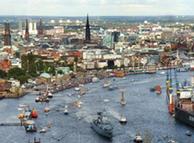 هامبورج مسقط رأس هيلموت شميت
 كتاب "قوى المستقبل" أحدث مؤلفات شميتيعتبر هيلموت شميت من المؤيدين لفكرة أوروبا الموّحدّة، وهو يدافع عن فكرة قديمة مؤدّاها أنّ أوروبا القديمة لن تنحدر خلال القرن العشرين ،إذا عرف الأوروبيين كيف يجعلون من الإتحّاد الأوروبي كيان موحّد وقادر على الحركة. وهو يعوًل على الجبهة الالمانية الفرنسية اهمية خاصة في جعل اوروبا قوية وموحدة.ولهيلموت شميت في هذا الصدد ثلاثة مبادئ استرتيجية هي: المحافظة على تكامل الموقفين الالماني ـ الفرنسي بإعتبارالبلدين هما المحرك الفعلي للاتحاد، وتكامل المصالح الأوروبية لتشكيل قوّة حقيقية، وضرورة الوصول الى مفهوم الدفاع الموحّد لهذا الإتحاد الأوروبي.
